AI Summer Workshop
Join Us Virtually
ATLIS AI Summer Workshop: Where Vision Becomes Action
This hands-on series is for schools ready to move from ideas to implementation.
Now in its third year, this highly popular summer workshop explores how independent schools are finding a thoughtful balance in their use of AI.
As AI becomes part of school life, leaders are asking more nuanced questions. How do we balance innovation with ethics? Efficiency with human judgment? Technical skill-building with student wellness? STEM applications with the humanities, arts, and broader academic life?
This year’s series will focus on what balanced AI implementation looks like in practice. Sessions will highlight real examples from independent schools as they design courses, build guardrails, respond to emerging risks, support faculty, and engage families in meaningful conversations.
Across the four sessions, we’ll explore:
Screen time and student wellness
How schools are thinking about AI alongside broader concerns about attention, wellbeing, and healthy technology use.
Environmental impact and sustainability
How schools can help students and adults understand the energy, infrastructure, and environmental questions connected to AI.
Balanced AI integration across the curriculum
How schools are incorporating AI into different content areas, including science, humanities, arts, and interdisciplinary learning.
Ethical and responsible AI use
How schools are setting expectations, addressing deepfakes and emerging risks, and helping students make informed choices.
Practical AI use for faculty and leaders
How AI agents and other tools can support school operations, teaching, planning, and professional work while keeping human expertise at the center.
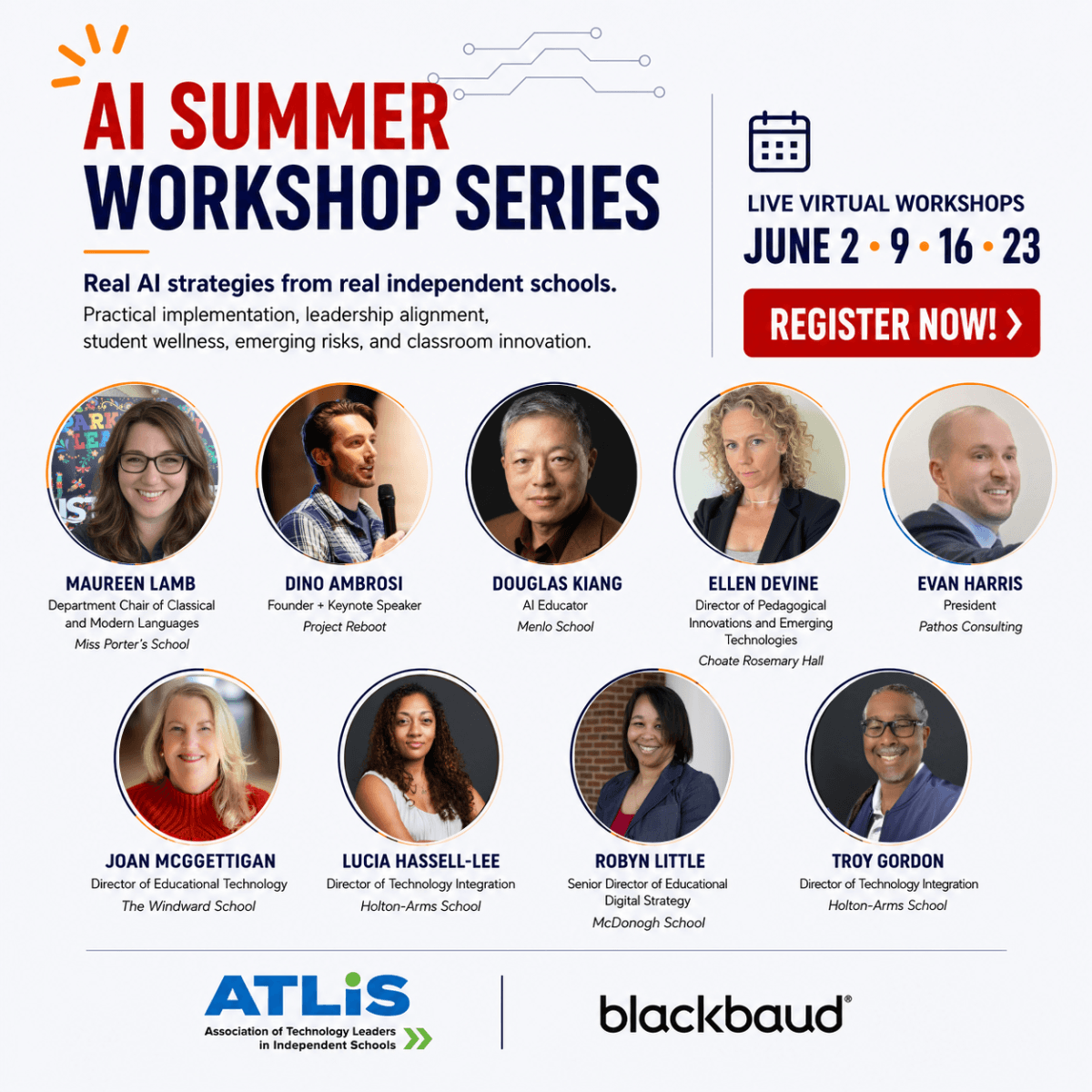
These topics are grounded in real examples from independent schools across the country, including work being done at Menlo School, McDonogh School, The Windward School, Holton-Arms School, Miss Porter’s School, and Choate Rosemary Hall, along with perspectives from Evan Harris of Pathos Consulting and Dino Ambrosi of Project Reboot.
Sessions are discussion-based and practical. Participants will leave with ideas, examples, and strategies they can adapt to their own school communities.
Summer Virtual Deep Dive Sessions (Tuesdays in June)
June 2, 9, 16, and 23
3 – 4:30 p.m. ET
Each 90-minute session will feature practical training and collaborative discussions.
All sessions are live via Zoom and will bring together cross-functional school teams for momentum-building collaboration and accountability. Sessions will be recorded and sent to all attendees. We understand summer is busy, and some participants will need to watch the archive.
You will receive a unique join link that tracks your attendance. Please save your confirmation e-mail to ensure you can join the workshop.
The intended audience work this workshop includes anyone who is part of your AI Committee. If you don’t have a committee yet, it could include your Heads of School, Divisional Directors, Tech Leaders, Teacher Representatives, Administrative Teams, etc. We don’t recommend more than 15 people from a school.
Implementation-focused training
No fluff. We’ll get into real strategy, tools, and training frameworks tailored specifically for your independent school context, enabling immediate implementation.
Cross-functional leadership approach
Designed for teams: bring your Head of School, Division Directors, Technology Leaders, and Academic Administrators to collaboratively lead meaningful AI integration.
Registration Options
|
Registration Options
|
Credits | Price |
|---|---|---|
|
AI Workshop (non-member)
|
6.00 (TLIS) | $995.00 |
Agenda
| June 2 | |
| 3:00 PM - 4:30 PM | June 2: AI in the Curriculum and Practical AI Agents Douglas Kiang (Menlo School) will share how his school is developing AI-forward courses, including interdisciplinary work between Computer Science and English. Maureen Lamb (Miss Porter’s School) will introduce custom AI agents, including examples of how reusable, document-informed AI tools can support teaching, leadership, and operational workflows. You will use Maureen’s framework to create your own custom AI agent. |
| June 9 | |
| 3:00 PM - 4:30 PM | June 9: Deepfakes and Emerging Risks Evan Harris (Pathos Consulting) will explore deepfakes, misinformation, and emerging AI risks facing schools. Robyn Little (McDonogh School) will lead an interactive discussion to help participants think through practical responses in their own communities. |
| June 16 | |
| 3:00 PM - 4:30 PM | June 16: Ethical Integration and Student-Driven Adoption Joan McGettigan (The Windward School) will share AI integration in academic technology, including faculty PD, student research hubs, creative tools, and multimodal demonstrations of learning. Lucia Hassell-Lee and Troy Gordon (Holton-Arms School) will highlight student-led AI adoption, faculty committee structures, roadmap development, and practical tools for ethical classroom use. We’re still working on the logistics, but we’re also trying to secure student presenters. |
| June 23 | |
| 3:00 PM - 4:30 PM | June 23:Environmental Impact, Screen Time, and Wellness Ellen Devine (Choate Rosemary Hall) will discuss the environmental impact of AI and how schools can help faculty and students consider responsible use. Dino Ambrosi (Project Reboot) will lead an interactive session on mindful technology use, including AI, and screen time balance. Dino will walk you through practical strategies you can use with your faculty, student, and parent community to address screen time in a healthy way. |
For More Information: